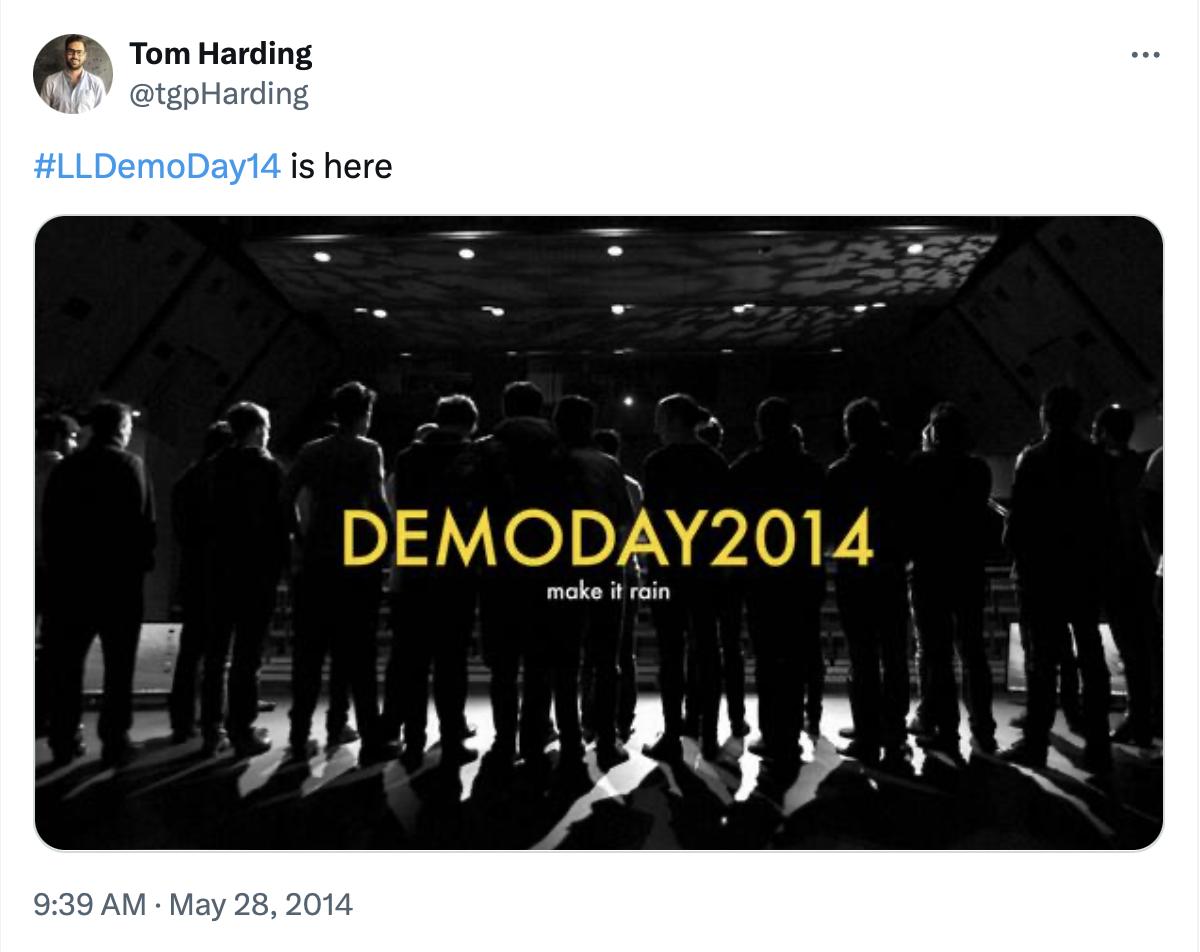
“Make it rain”, said the tweet posted by one of the handful of young founders who had been selected for the Lightning Lab accelerator programme in 2014. The accompanying image showed a bright spotlight shining through the silhouettes of a group of people standing on a stage.1 I had an immediate visceral reaction.
It was innocently intended to promote the upcoming “demo day” event that marked the end of the second iteration of that programme, run by CreativeHQ in Wellington. I imagine the photo was taken at the venue as the founders rehearsed their pitches. Getting on stage so soon after starting a new venture is incredibly brave, and they would have no doubt been buzzing with nervous excitement. So why was my response so negative?
Perhaps it was jet lag. I’d recently returned from a long trip to the US and Canada with Vaughan. I was deep in Vend, which had quickly soaked up all my time. I was learning all over again the stamina that a high-growth startup demands. No doubt it was partly frustration. I hated to see what I perceived to be the worst bits of Silicon Valley startup culture popping up in New Zealand, without any of the associated things that make the original great. After trying (and mostly failing) to “be more American”, meeting with investors in the US had taught me the value of highlighting our own competitive advantages. A small part of it was probably envy. I knew a long list of other worthy startups that would have loved to get even a fraction of the public attention that the Lightning Lab was soaking up. But mostly I just hated that metaphor. It was awful to see the founders who had completed this programme put on a pedestal so early, and then encouraged to parade like strippers asking a room full of investors to throw money at them. And it was discouraging, as a potential investor, to be commoditised and reduced to the equivalent of a stack of hundred dollar bills. It all felt gross.
I posted a response where I suggested that the mentors who were advising founders to approach investors in this way were “naive and wrong”. One who (reasonably enough) took offence at that description was Dave Moskovitz. He snapped back in comments on the NZ Tech Startup Eco-system Facebook group:2
It’s easy for Rowan Simpson to take pot-shots from the sidelines. He has no idea how many people slogged their guts out, both out front and behind the scenes, how many people have backed this effort over a number of years, just to help everyone lift their game and improve the general environment for startups in Wellington and NZ. I’ll pay more attention to what he says when I see more evidence of unselfish behaviour on his part.
Ouch! While it stung to be branded a hater, it did force me to articulate specifically what I didn’t like about the efforts to “lift the general environment”. I was being dismissive, but he was wrong about my motivation. I was playing the ball, not the man. I was very aware of how much time and money he and many others had put in. I wasn’t trying to belittle that. I just didn’t think it was a good investment. My criticism wasn’t intended to drag anybody down, but rather to shine a spotlight on an alternative.
I’d decided to put all of my “selfish” energy into working with a small and carefully selected group of founders to quietly help them to grow their businesses. I wasn’t visible, apart from when I popped up to make seemingly critical comments like this, but the results have subsequently justified the conviction I had about the merits of my approach.
-
Tom Harding, Twitter, May 2014. ↩︎
-
I love it when people just say what they think, no holds barred, NZ Tech Startup Eco-system group on Facebook, June 2014. ↩︎